For the simple reason that USB drives go missing often is that they are portable and sometimes small. The best way to mark ownership is with one of the permanent marker pens. However, naming the USB drive will tell everyone who it belongs to when it is plugged in.
Just maybe, that missing USB drive containing your phone number will come back to you if found.
Here is how to name the disk on Kubuntu 9.10 or other similar Linux like CentOS.
Step 1:
Insert the USB disk and determine the device and partition. E.g. /dev/sdb1
Easily done with the mount command.
Step 2:
Unmount the disk (Do not unplug from the USB).
sudo umount /dev/sdb1
Step 3:
Check existing disk name
sudo mlabel -i /dev/sdb1 -s ::
Step 4:
Rename the disk label. E.g. below, replace the word "myphonenumber" with anything you like with a limit of 12 characters.
sudo mlabel -i /dev/sdb1 -s ::myphonenumber
Step 5:
Remove the USB disk, and reinsert back to confirm the name has changed.
For more details see ubuntu.com
Thursday, April 8, 2010


Tuesday, March 9, 2010
ThunderBird 2.0 Add-ons
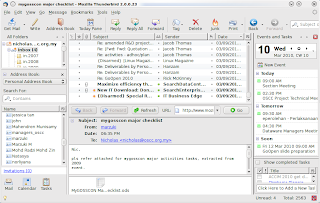
Thunderbird 2.0 reached EOL Aug 2009 but Thunderbird 3.0 still does not have all the stuff and attractions for an upgrade, so here I am still using Thunderbird 2.0. What is Thunderbird?
Its an Email client, Calendering, Task and Contact Management. Allows access to Email accounts via POP or IMAP. It also supports GMail accounts, Unix mailbox and Newsgroup account access. A really great application to work with.
Some of the must have add-ons for my Thunderbird 2:
Other optional add-on:
Its an Email client, Calendering, Task and Contact Management. Allows access to Email accounts via POP or IMAP. It also supports GMail accounts, Unix mailbox and Newsgroup account access. A really great application to work with.
Some of the must have add-ons for my Thunderbird 2:
- Contacts Sidebar 0.7 - Allows me to forward VCards and access via F4 the addresses, copy and paste info of the VCard into email.
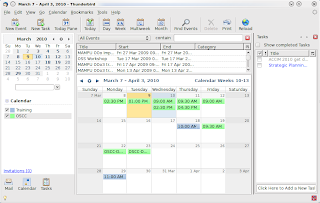
- Lightning 0.9 - The calendar and task Manager
- FG Printers 0.4.4 - Format printing if the calendars
- VCS Support 0.6.3.1 - Allows me to import/export VCS calendars
- Automatic Export 0.3.0 - Allows automatic backup of the calendars


Other optional add-on:
- Provider for Google Calendar
- Bidi Mail UI
- PGP
- Thunderbrowse


Thursday, March 4, 2010
Linux driver in use
From a terminal window;
To view all device drivers and the module names
$ lspci -k
To view a specific device (e.g. 03:00)
$ lspci -vv -s 03:00
To view all the loaded modules (The letter 'K' is uppercase in Kernel)
$ lsmod
$ lspci -k |grep Kernel
To view all device drivers and the module names
$ lspci -k
To view a specific device (e.g. 03:00)
$ lspci -vv -s 03:00
To view all the loaded modules (The letter 'K' is uppercase in Kernel)
$ lsmod
$ lspci -k |grep Kernel
Monday, March 1, 2010
Installing Kubuntu 9.10
Just did a fresh install for Kubuntu 9.10 based on my previous install. Here is a list of steps I took to get my most common applications working.
Post installation recommendations
Start the Kubuntu software(package) installer by Kmenu ->Application ->Systems ->KpackageKit
Post installation recommendations
Start the Kubuntu software(package) installer by Kmenu ->Application ->Systems ->KpackageKit
Choose following packages:
- openjdk-6-jre-hotspot
- mozilla-thunderbird-2.0.0.23
- lightning-extension
- flashplugin-installer
Install Firefox web browser
Choose Kmenu ->Internet ->Firefox Web Browser Installer
To allow Java applications to run in the web browser, open a terminal and install the openjdk plugin;
$ sudo apt-get install icedtea6-plugin
To get the wireless working, run at terminal this command and reboot. My wireless router for WPA, TKIP did not connect until following steps were taken. Open a terminal and type
$ sudo /etc/init.d/network-manager restart
Install the other stuff for common applications to be used. At the terminal run
$ sudo apt-get install msttcorefonts
For multimedia, fonts and assorted codecs support
This will add JRE, mp3, mpeg, odbc, unrar and other useful support.
$ sudo apt-get install kubuntu-restricted-extras
This allows the disk to be encrypted and manage passwords. Additional encryption can be downloaded from http://www.truecrypt.org/downloads or mediafire.
$ sudo apt-get install gdecrypt password-gorilla
Allow secure SSH connection to and from SSH servers.
$ sudo apt-get install ssh sshfs ksshaskpass kdessh
Install the VLC video player to watch CD and DVD movies.
$ sudo apt-get install vlc videolan-doc mozilla-plugin-vlc vlc-plugin-sdl libvcdinfo0
Install basic Thunderbird add-ons to enhance its usage. From a web browser enter the URL https://addons.mozilla.org/en-US/thunderbird
Download and install the following;
- Automatic Export
- Bidi Mail UI (not needed if installed as earlier)
- FG Printers
- Lightning (not needed if installed as earlier)
- Provider for Google Calendar (not needed if installed as earlier)
- Thunderbrowse
To improve web browsing, these are my download addons from https://addons.mozilla.org/en-US/firefox
- FoxTabs
- Speed Dials
- Zotero
- Server spy
- Video download helper
- Firebug
Wednesday, February 24, 2010
How a small office can switch to open source?
During small talk sessions the topic of having offices switching to Open Source Software (OSS) intrigued me to write this piece. Its in no mean very deep but gives you considerations to start the office moving towards a secure, efficient, cost saving and almost virus free environment.
Must have apps for the office hard working staff:
Once you have gotten all of the staff interested and comfy with the Linux desktop you can then start integrating with linux services in a networked office.
An office of 4 or more people should have a server or more with the following must have services:
There are loads of other projects that can be done once you have the above in order and your tech guy is happily getting used to OSS.
Must have apps for the office hard working staff:
- Office productivity suite (prepare letters, reports, spreadsheet and presentation slides) - OpenOffice.org
- Email clients - Thunderbird + Calendar
- Document viewer - Acrobat Reader
- Desktop publishing tools such as flyers and posters - Scribus
- Financial tool - GnuCash
- Project management and monitoring - OpenProj
- Graphics and photo editing tool - GIMP, F-SPOT, GwenView, XSane Image Scanning, Mobile Media Converter
- Backup data to CDROM or DVDROM, network - K3B, Simple Backup
- Web browsing - Firefox
- Encryption of files/data - GDecrypt, TrueCrypt, Password Gorilla
- Internet calls/VOIP - Skype
- Multimedia player - VLC
- Base apps/interpreter for other programmes to run - Java Runtime Environment, Flash, Wine, PHP5
Once you have gotten all of the staff interested and comfy with the Linux desktop you can then start integrating with linux services in a networked office.
An office of 4 or more people should have a server or more with the following must have services:
- Printer sharing - CUPS
- Cetralised file/document sharing - PLONE or Open Atrium
- Global address book - LDAP or Customer management suite (see below)
- Local DNS - BIND
- Customer management - vtiger or SugarCRM Community Edition (Asertiva)
- Automated networked backup - Bacula
- Centralised time server - NTPD
- Local email server? Most small office use public email services.
There are loads of other projects that can be done once you have the above in order and your tech guy is happily getting used to OSS.
Monday, February 8, 2010
MCRYPT module for PHP (RHEL5)
RHEL5.3 did not have support for the MCRYPT module that many PHP applications use to create basic security. Well, anyone could download mcrypt from sourceforge and recompile PHP to support this module. I found another way which I hope also will work for you;
Step 1: Login as admin and install MCRYPT
yum install mcrypt
Step 2: Install epel
http://download.fedora.redhat.com/pub/epel/5/i386/epel-release-5-3.noarch.rpm
rpm -Uvh epel-release*.rpm
Step 3: Install the module
yum install php-mcrypt.i386
Step 4: Restart Apache
service httpd restart
Confirmation of the installed module can be found from the phpinfo() page. The module I had included cipher for
cast-128
gost
rijndael-128
twofish
arcfour
cast-256
loki97
rijndael-192
saferplus
wake
blowfish-compat
des
rijndael-256
serpent
xtea
blowfish
enigma
rc2
tripledes
Step 1: Login as admin and install MCRYPT
yum install mcrypt
Step 2: Install epel
http://download.fedora.redhat.com/pub/epel/5/i386/epel-release-5-3.noarch.rpm
rpm -Uvh epel-release*.rpm
Step 3: Install the module
yum install php-mcrypt.i386
Step 4: Restart Apache
service httpd restart
Confirmation of the installed module can be found from the phpinfo() page. The module I had included cipher for
cast-128
gost
rijndael-128
twofish
arcfour
cast-256
loki97
rijndael-192
saferplus
wake
blowfish-compat
des
rijndael-256
serpent
xtea
blowfish
enigma
rc2
tripledes
Friday, February 5, 2010
Print repeat header in Calc
Calc is a great electronic spreadsheet and have lots of functions to create a diverse range of apps.
Since my upgrade to OpenOffice.org 3.1.1, I have not explored Calc much. When I tried to print a spreadsheet that ran across 40 pages. I tried to have the first 2 rows repeat as headers in every page, an error appeared "Invalid Sheet Range".
Solution:

Some trigger must have failed to detect the values as "Calc A1". Thank you Arnel for giving the solution in Oct 2009.
Since my upgrade to OpenOffice.org 3.1.1, I have not explored Calc much. When I tried to print a spreadsheet that ran across 40 pages. I tried to have the first 2 rows repeat as headers in every page, an error appeared "Invalid Sheet Range".
Solution:
- Open the Calc spreahsheet.
- In the menu choose Tools ->Option ->OpenOffice.org Calc ->Formula
- In Formula Syntax, it shows "Calc A1". Click on the dropdown box and choose "Calc A1".
- Click "Ok".
Some trigger must have failed to detect the values as "Calc A1". Thank you Arnel for giving the solution in Oct 2009.
Sunday, January 31, 2010
Oracle takes out the Sun
Oracle has finally taken over Sun Microsystems. Days of darkness are here but how long will it be?
 Sun is not only about hardware. What will happen to OpenOffice.org, Java and MySQL? How about the Sun and MySQL Certifications?
How will Jonathan, being the last Sun Microsystem's CEO end his career there?
All the debates are ongoing in the internet but I look forward to Oracle making clear statements on these concerns.
 Sun is not only about hardware. What will happen to OpenOffice.org, Java and MySQL? How about the Sun and MySQL Certifications?
How will Jonathan, being the last Sun Microsystem's CEO end his career there?
All the debates are ongoing in the internet but I look forward to Oracle making clear statements on these concerns.
Tuesday, January 26, 2010
Kubuntu 9.10 on PIII
Ubuntu released the 9.10 Karmic last year. Due to all the hectic schedule I finally managed to install Kubuntu 9.10 today.
Kubuntu is installed on a Pentium III with 200Mb RAM having 20Gb hard disk. Mouse is with the Nano wireless and keyboard is PS2. With the L2 cache being 512k, it should mean something to Kubuntu to run smoothly (almost). Working just ok, and the desktop looks neat. Swap is taking up 144Mb of the 1,400Mb allocated during installation.
Following are among the first thing I did after install;
1. Did a system update and removed the package kubuntu-firefox-installer.
2. Set the screen to resolution to 1024x768
3. Checked with Konqueror the Internet connection...connected to the broadband via router.
3. Used KPackagerKit to install Firefox 3.5
4. Added stuff like password gorilla, Kphotoalbum
List of things to do next:
1. Install Java and Flash
2. Get a PDF reader. Currently Okular is installed by default.
Kubuntu is installed on a Pentium III with 200Mb RAM having 20Gb hard disk. Mouse is with the Nano wireless and keyboard is PS2. With the L2 cache being 512k, it should mean something to Kubuntu to run smoothly (almost). Working just ok, and the desktop looks neat. Swap is taking up 144Mb of the 1,400Mb allocated during installation.
Following are among the first thing I did after install;
1. Did a system update and removed the package kubuntu-firefox-installer.
2. Set the screen to resolution to 1024x768
3. Checked with Konqueror the Internet connection...connected to the broadband via router.
3. Used KPackagerKit to install Firefox 3.5
4. Added stuff like password gorilla, Kphotoalbum
List of things to do next:
1. Install Java and Flash
2. Get a PDF reader. Currently Okular is installed by default.
Sunday, December 20, 2009
Enable user directories in Apache2
Its been a while since Apache2 was introduced. The configurations are found in apache2.conf and user specific settings can be added to httpd.conf in the /etc/apache2 directory. One major difference from previous version is the method to enable the user directory modules.
The Linux users can have their individual websites but this needs to be enabled and the web server restarted. At the command line type
sudo a2enmod userdir
sudo /etc/init.d/apache2 restart
This enables the Userdir module in /etc/apache2/mods-enabled/userdir.conf and users can create pages in the directory /home/username/public_html
This is managed by the directive
Other basic configurations can be
The Linux users can have their individual websites but this needs to be enabled and the web server restarted. At the command line type
sudo a2enmod userdir
sudo /etc/init.d/apache2 restart
This enables the Userdir module in /etc/apache2/mods-enabled/userdir.conf and users can create pages in the directory /home/username/public_html
This is managed by the directive
<directory /home/*/public_html>
Other basic configurations can be
- Disable a user from serving webpages (e.g. root and user1)
Userdir disabled root user1 - Access URL as http://servername/~username
Userdir public_html - Access URL as http://servername/web/username
Userdir web
Thursday, October 29, 2009
MyGOSSCON 2009 on theStar
The latest promotion on the Malaysian Government Open Source Software Conference 2009 or MyGOSSCON is on the theStar newspaper today, see "A Vision Becomes Reality"
Tuesday, October 13, 2009
Upcoming MyGOSSCON 2009 Conference
The 3rd in the series of conference for the Malaysian Government on OSS will be coming this 5-6th October 2009 at PICC, Putrajaya.
To kick off the conference, following events have been scheduled:
-x-

To kick off the conference, following events have been scheduled:
- OpenOffice.org contest (for primary students to show off their skills on OSS presentation tools)
- OSS Case Study Award (Government and Institution of Higher Learnings share their OSS experiences through a write up of their implementations)
- 24-Hour WebDev Contest (Allow groups of programmers to compete heads on to grab a chance to show-off their skills)
-x-
Sunday, September 20, 2009
[Jaunty] Firefox Foxtab
Firefox provides a large number of extensions that enhances the user experience. The extension to increase its fancy tab switching is called FoxTab. Install this and on the superb KDE display, things get even better. I have version 1.2.1 on Firefox 3.0.14.
Once installed, use the F12 key to view multiple tabs.
I dont use a mouse that much but if you do, make full use of its mouse gestures. E.g. Hold the left mouse button, then hit the right mouse to launch the Interactive mode of Foxtab. The next time you need to do a presentation on web apps, try it with Foxtab. In terms of memory usage, when Firefox with 6 tabs (includes images) an average of 105,120k memory is used. Launching the Foxtab this increased to 108,492k on average. This is about 3,000k of extra memory is used.
Once installed, use the F12 key to view multiple tabs.
I dont use a mouse that much but if you do, make full use of its mouse gestures. E.g. Hold the left mouse button, then hit the right mouse to launch the Interactive mode of Foxtab. The next time you need to do a presentation on web apps, try it with Foxtab. In terms of memory usage, when Firefox with 6 tabs (includes images) an average of 105,120k memory is used. Launching the Foxtab this increased to 108,492k on average. This is about 3,000k of extra memory is used.
[Kubuntu] Upgrade OOo 3.1.1
Just did an OpenOffice.org upgrade to 3.1.1 and it seems to be working fine on Jaunty. Additionally, I had to install the openoffice.org-kde and openoffice.org-style-oxygen.
The install provides OOo310m19 (build 9420).
For those who have been struggling with the slide transition preview, will now find it is much smoother. Same goes for the custom animations, great improvement. On the status bar of Impress, Calc and Writer it indicates when the document have been edited and needs to be saved.
The sliderbar to zoom is available for all 3 main components and you can also double click the zoom display to bring up the zoom dialog box.
Tried the overlining of text features, cool. Now, when will I ever need this?
There are a whole bunch of other features listed at OpenOffice.org
The install provides OOo310m19 (build 9420).
For those who have been struggling with the slide transition preview, will now find it is much smoother. Same goes for the custom animations, great improvement. On the status bar of Impress, Calc and Writer it indicates when the document have been edited and needs to be saved.
The sliderbar to zoom is available for all 3 main components and you can also double click the zoom display to bring up the zoom dialog box.
Tried the overlining of text features, cool. Now, when will I ever need this?
There are a whole bunch of other features listed at OpenOffice.org
Monday, August 24, 2009
London Stock Exchange to consider Linux?
The concern for performance in time sensitive financial environments is very real when the London Stock Exchange (LSE) had a system fault in Sept 2008. The TradElect system in place was MS Windows based and may be considered to be replaced as interviewed by Computerweekly and finextra.com.
During the recent visit by Redhat to Malaysia, the New York Stock Exchange (NYSE) was mentioned as an example of financial systems using Linux. The trading speed of 0.4 milliseconds have been mentioned in the same article. This is almost double the speed of the TradElect but will the investment of billion of Pounds justify replacing it with another new system like Linux? Anyone knows what KLSE is using?
Financial systems world wide looking at the future of their architecture might learn a lesson or two with how the LSE takes charge of their investment and business needs.
During the recent visit by Redhat to Malaysia, the New York Stock Exchange (NYSE) was mentioned as an example of financial systems using Linux. The trading speed of 0.4 milliseconds have been mentioned in the same article. This is almost double the speed of the TradElect but will the investment of billion of Pounds justify replacing it with another new system like Linux? Anyone knows what KLSE is using?
Financial systems world wide looking at the future of their architecture might learn a lesson or two with how the LSE takes charge of their investment and business needs.
Monday, August 17, 2009
[kubuntu] Rename FAT label
The Kubuntu Jaunty did not allow me to change the USB diskdrive label. This I found was because it is FAT32 formated. Why would I want to change the label and maintain it as FAT32 format?
Step 1: Install mtools if not already done.
$ sudo apt-get install mtools
Step 2: Identify the USB diskdrive (or partition) to be formatted.
Plug in the USB diskdrive. Then identify the USB device in a terminal, type:
$ tail /var/log.messages
I found mine as /dev/sdb1
Step 3: Rename the label with 11 characters maximum
$ sudo mlabel -i /dev/sdb1 ::0161234567
Test the results by unplugging the device, then plug back in to see the difference. Thank to the reference at Ubuntu.com website.
- If someone finds my disk and would care to return it, they can mount it and find my phone num ber as the label.
- The FAT32 allows me to plug the USB diskdrive to MS Windows and Linux operating system interchangeably.
- I backup to this disk for both operating system.
Step 1: Install mtools if not already done.
$ sudo apt-get install mtools
Step 2: Identify the USB diskdrive (or partition) to be formatted.
Plug in the USB diskdrive. Then identify the USB device in a terminal, type:
$ tail /var/log.messages
I found mine as /dev/sdb1
Step 3: Rename the label with 11 characters maximum
$ sudo mlabel -i /dev/sdb1 ::0161234567
Test the results by unplugging the device, then plug back in to see the difference. Thank to the reference at Ubuntu.com website.
Tuesday, July 28, 2009
Yahoo Messenger upgrades its servers
Early this month I failed to connect the Kopete 0.70.2 to Yahoo Messenger. There were several suggestions to use alternate messenger server IP manually. Initially it worked, but soon all of the suggested servers failed.
This was due to Yahoo upgrading their servers. Matt Rogers, the maintainer for Kopete soon received info from Pidgin maintainers on the authentication changes. Yahoo have upgraded its authentication to version 15 from version 13 and this is now resolved. But the KDE 4.2 based distros may well have to wait for a package on this. In the mean time, revert to Pidgin or compile from Kopete SVN.
Howto on installing from SVN
Step 1: Install svn client from a terminal.
Step 2: Install the tools to compile (generate the executables) from a terminal
Step 3: Follow are instructions from kopete.kde.org in a terminal
If you get errors below on building, then it may require the other libraries to build the KDE source.
CMake Error at /usr/share/cmake-2.6/Modules/FindPackageHandleStandardArgs.cmake:57 (MESSAGE):
Could NOT find KdepimLibs (missing: KdepimLibs_CONFIG)
Call Stack (most recent call first):
/usr/share/kde4/apps/cmake/modules/FindKdepimLibs.cmake:73 (find_package_handle_standard_args)
CMakeLists.txt:33 (find_package)
Solution: Read the KDE4 build instructions and at a terminal type following before you resume where you left off in step 3. This will take a good 270Mb+ but you can install any future source from KDE easily.
sudo apt-get install kdepimlibs5-dev
Test Kopete with the Yahoo Messenger account. The package can be removed with the command
sudo make uninstall kopete
This was due to Yahoo upgrading their servers. Matt Rogers, the maintainer for Kopete soon received info from Pidgin maintainers on the authentication changes. Yahoo have upgraded its authentication to version 15 from version 13 and this is now resolved. But the KDE 4.2 based distros may well have to wait for a package on this. In the mean time, revert to Pidgin or compile from Kopete SVN.
Howto on installing from SVN
Step 1: Install svn client from a terminal.
sudo apt-get install subversion subversion-tools
Step 2: Install the tools to compile (generate the executables) from a terminal
sudo apt-get install cmake
sudo apt-get install libqt4-dev kdelibs5-dev  [36Mb +]
sudo apt-get install libqimageblitz-dev [33Mb+]
Step 3: Follow are instructions from kopete.kde.org in a terminal
svn co -N svn://anonsvn.kde.org/home/kde/trunk/KDE/kdenetwork
cd kdenetwork
svn up kopete cmake
mkdir ../kdenetwork-build
cd ../kdenetwork-build
cmake ../kdenetwork
make
sudo make install
If you get errors below on building, then it may require the other libraries to build the KDE source.
CMake Error at /usr/share/cmake-2.6/Modules/FindPackageHandleStandardArgs.cmake:57 (MESSAGE):
Could NOT find KdepimLibs (missing: KdepimLibs_CONFIG)
Call Stack (most recent call first):
/usr/share/kde4/apps/cmake/modules/FindKdepimLibs.cmake:73 (find_package_handle_standard_args)
CMakeLists.txt:33 (find_package)
Solution: Read the KDE4 build instructions and at a terminal type following before you resume where you left off in step 3. This will take a good 270Mb+ but you can install any future source from KDE easily.
sudo apt-get install kdepimlibs5-dev
Test Kopete with the Yahoo Messenger account. The package can be removed with the command
sudo make uninstall kopete
Sunday, June 14, 2009
[Jaunty] Configure program at system boot up
The tpb services can be started from the command line as follows
/etc/init.d/tpb start
This allowed the interaction with some of the Thinkpad laptop special function keys. Now, how can I get this activated automatically during bootup?
Previously, KDE provided KControl where I can choose the various programs available to start or not during system boot. In Jaunty and KDE 4.2, its gone! Here I list 3 alternative ways to manage this. First 2 require users to have a basic knowledge of the runlevels.
METHOD 1: Back to old debian school!
Step 1. Install the sysv-rc-conf from a terminal
sudo apt-get install sysv-rc-conf
Step 2. Run the program, choose what you want activated at each Runlevel.
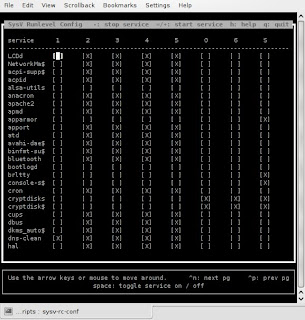
To select the next page press Control+n or p. Other than that just use the cursor arrows to move to different services.
METHOD 2: Use Gnome Bum. Better to also understand scripts priority that begin with "K" means to shutdown, "S" to start up.
Step 1: Install the Bum with the terminal.
sudo apt-get install bum
Step 2: Start the Bum.
From the KMenu ->Application ->System ->Bootup Manager
Since its menu driven, should be easier to figure out.
METHOD 3: Start a script during login, with KDE Autostart
Step 1: In KDE systems, all scripts located in ~/.kde/Autostart will automatically run when a user logs in (Where the ~ means your home directory). Create a new file called mytpb.sh with the following contents to start thinkpad sound mixer;
#!/bin/sh
export LD_LIBRARY_PATH=/usr/local/lib:$LD_LIBRARY_PATH
tpb -m on
Step 2: Save the file.
Step 3: Change the mode to executable
$ chmod u+x ~/.kde/Autostart/mytpb.sh
Step 4: Logout, then log back in.
You can then try the Thinkpad's volume control. This should produce the on screen display (OSD) of the volume bar. Other settings can be configured in the /etc/tpbrc or ~/.tpbrc
/etc/init.d/tpb start
This allowed the interaction with some of the Thinkpad laptop special function keys. Now, how can I get this activated automatically during bootup?
Previously, KDE provided KControl where I can choose the various programs available to start or not during system boot. In Jaunty and KDE 4.2, its gone! Here I list 3 alternative ways to manage this. First 2 require users to have a basic knowledge of the runlevels.
METHOD 1: Back to old debian school!
Step 1. Install the sysv-rc-conf from a terminal
sudo apt-get install sysv-rc-conf
Step 2. Run the program, choose what you want activated at each Runlevel.

To select the next page press Control+n or p. Other than that just use the cursor arrows to move to different services.
METHOD 2: Use Gnome Bum. Better to also understand scripts priority that begin with "K" means to shutdown, "S" to start up.
Step 1: Install the Bum with the terminal.
sudo apt-get install bum
Step 2: Start the Bum.
From the KMenu ->Application ->System ->Bootup Manager
Since its menu driven, should be easier to figure out.
METHOD 3: Start a script during login, with KDE Autostart
Step 1: In KDE systems, all scripts located in ~/.kde/Autostart will automatically run when a user logs in (Where the ~ means your home directory). Create a new file called mytpb.sh with the following contents to start thinkpad sound mixer;
#!/bin/sh
export LD_LIBRARY_PATH=/usr/local/lib:$LD_LIBRARY_PATH
tpb -m on
Step 2: Save the file.
Step 3: Change the mode to executable
$ chmod u+x ~/.kde/Autostart/mytpb.sh
Step 4: Logout, then log back in.
You can then try the Thinkpad's volume control. This should produce the on screen display (OSD) of the volume bar. Other settings can be configured in the /etc/tpbrc or ~/.tpbrc
Friday, June 5, 2009
[Jaunty] Managing sound device
The recent Kubuntu 9.04 Linux uses the Pulseaudio to manage its sounds device selection. To enable all sound devices to use the Pulseaudio sound server, open a terminal and type
asoundconf set-pulseaudio
Any application that need to access the audio, including the ALSA will be sent to the Pulseaudio server. The settings can be configured at
/usr/share/alsa/pulse-alsa.conf
Open or play a movie or sound and test if it works. If this does not work, reset back to use the default ALSA system with the command;
asoundconf reset-default-card
I am still trying to figure out the significant benefit of using Pulseaudio.
asoundconf set-pulseaudio
Any application that need to access the audio, including the ALSA will be sent to the Pulseaudio server. The settings can be configured at
/usr/share/alsa/pulse-alsa.conf
Open or play a movie or sound and test if it works. If this does not work, reset back to use the default ALSA system with the command;
asoundconf reset-default-card
I am still trying to figure out the significant benefit of using Pulseaudio.
Wednesday, June 3, 2009
[Jaunty] Firefox can use apt://
Some URLs accessed by Firefox is used to install packages for Linux. For example the URL to add the canonical cloud client.
apt://ubuntuone-client?refresh=yes
I get the following message.
Firefox doesn't know how to open this address, because the protocol (apt) isn't associated with any program.
Solution.
I started synaptic and added the package apturl, searched for Ubufox extension for Firefox. Restarted Firefox and now I can access the URL.
apt://ubuntuone-client?refresh=yes
I get the following message.
Firefox doesn't know how to open this address, because the protocol (apt) isn't associated with any program.
Solution.
I started synaptic and added the package apturl, searched for Ubufox extension for Firefox. Restarted Firefox and now I can access the URL.
Subscribe to:
Posts (Atom)